iDrive Meets 'I, Robot': BMW Using Humanoid Robots To Build Cars
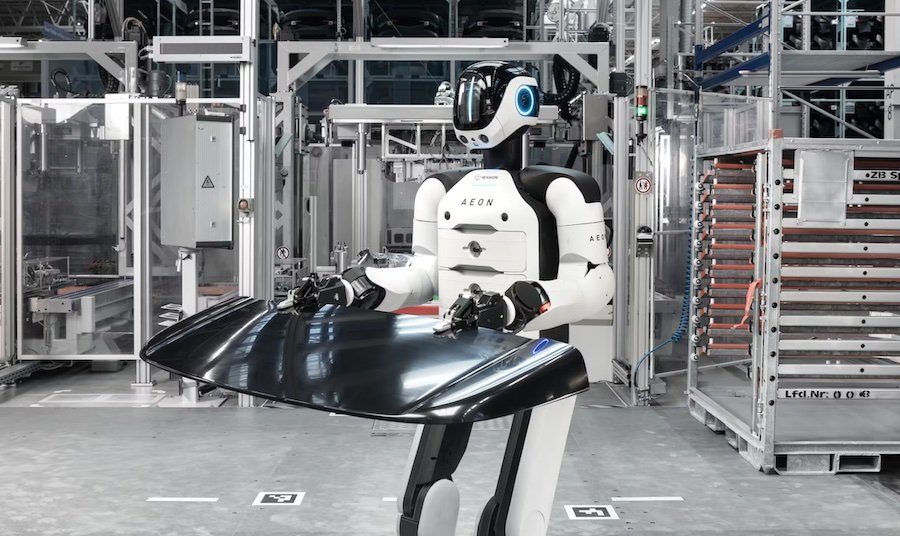
But until recently, most of those robotic devices were massive arms or enormous presses that were fixed in place. BMW may change that perception with the "Physical AI" pilot program, whose humanoid robot experiment just ended a successful run at its factory in Spartanburg, South Carolina, last year before being adopted by the plant in Leipzig last week.
Putting A Friendly Face On Things
Now, to be more accurate, the robot itself isn't making the intercontinental journey from the American South to Germany. BMW undertook the Spartanburg pilot program in partnership with robotics startup Figure, which supplied the Figure 02 robot to work 10-hour shifts at the factory building the X3. The humanoid was responsible for positioning sheetmetal during precise welding operations, an action that requires millimeter accuracy and can be very physically taxing on humans. During its time at Spartanburg, Figure 02 supported the production of 30,000 X3 crossovers, moving more than 90,000 pieces of metal and walking an average of 9,600 steps per day.
But instead of Figure 02, the Leipzig factory's pilot program will involve robots from Hexagon, a company that has been a longtime BMW partner on software and sensor development. Hexagon Robotics will provide Leipzig with AEON, an AI-powered bot with human-like hands, articulated legs, and rolling feet that will give it freedom of movement to accomplish a number of challenging tasks. AEON was first introduced to the factory in December to ensure it would be able to operate within its walls, with another longer-form test run planned for April. The pilot program will begin in earnest this summer.
What Can A Humanoid Robot Do?
Figure 02, the fella used in Spartanburg, had one precise, repeatable task, but it sounds like BMW has a slightly more diverse workload in mind for AEON. The robot's hands and fingers can accommodate a number of apparati, like scanning tools and grippers, meaning it could be used alongside a human worker to assist with lifting or moving heavy objects around the facility. Later in the program, BMW plans to test AEON in the manufacture of high-voltage batteries and electronic components, precise tasks that could be perfect for the cold hard logic of a robot.
The successful first deployment of humanoid robots at our BMW Group plant in Spartanburg in the USA proves that a humanoid robot can function not only under controlled laboratory conditions but also in an existing automotive manufacturing environment.
–Michael Nikolaides, BMW Senior Vice President Production Network, Supply Chain Management
Currently, the Leipzig factory builds the BMW 2 Series Gran Coupe and Mini Countryman, including the all-electric Countryman SE. We have asked BMW for comment on whether humanoid robots will become a common sight at its facilities and will update this story when and if the automaker responds. Now, as for whether these physical AI pilot programs will someday be used to stop crime before it happens or overthrow corrupt democracies, we doubt anyone but Isaac Asimov can comment on that.
Related News
